

You start the week with good intentions. You’ve got your training sessions planned, you’re feeling organised, and this is going to be the week you get back into a proper routine. Then work runs late. Something comes up at home. The weekend disappears. And suddenly, the sessions you’d planned are the first things to go.
Sound familiar?
When life gets busy, it’s easy to feel like your fitness routine has to be all or nothing. Either you’re training regularly and doing everything right, or you’ve completely fallen off track.
But a good routine shouldn’t only work when life is quiet. It should be flexible enough to fit around everything else you’ve got going on.
So, if you’re finding it difficult to stay consistent, here are five simple things that can help.
1. Set a minimum you can manage, even on your busiest weeks
It’s easy to plan your training around an ideal week. The one where work finishes on time, nobody needs anything from you and your diary is completely under control.
Unfortunately, those weeks don’t always come around very often.
Instead of planning everything around your best-case scenario, think about what you can realistically manage most weeks.
For example, your ideal routine might include three training sessions. But if work, family and other commitments regularly get in the way, two sessions might be a more achievable starting point.
And during a particularly hectic week? Even one session can help you maintain the habit.
Try this: Give yourself two versions of your routine:
- Your normal week: What you’d like to achieve when life is running relatively smoothly.
- Your busy week: The minimum you can realistically manage when everything else takes priority.
That way, when things get busy, you already have a plan to fall back on.
And remember, doing a little less for a week doesn’t mean you’ve failed. It means you’ve adapted.
2. Missed a workout? Find another way to move
If you can’t make your usual training session, it doesn’t mean movement has to disappear from your day altogether.
We often think of exercise as something that happens during a dedicated hour at the gym. But the movement you do throughout the rest of your day matters too. And on particularly busy days, small opportunities to be more active can add up.
That might mean:
- Taking a 20-minute walk during your lunch break.
- Walking to the shops instead of jumping in the car.
- Taking the stairs when you can.
- Getting outside for a walk with the kids or grandkids.
- Breaking up long periods at your desk with a few minutes of movement.
None of these activities needs to replace your structured strength training. And you don’t need to turn every spare moment into another workout.
It’s simply about recognising that something is better than nothing when your usual plans aren’t possible.
Try this: On days when you can’t train, ask yourself: “Where could I fit a little more movement into today?”
It doesn’t have to be complicated. Sometimes a walk around the block is all you’ve got time for, and that’s still worth doing.
3. Make your training appointments harder to cancel
When your diary starts filling up, the things that aren’t already planned tend to get pushed aside.
And if your approach to exercise is “I’ll fit it in when I have time”, you might find that time never appears.
One of the simplest ways to protect your routine is to make training a regular part of your weekly schedule. But it’s not just about putting a session in your diary. It’s about making it as easy as possible to get there.
A few things that can help:
- Book ahead. Schedule next week’s sessions before the current week finishes.
- Choose convenient times. If mornings are always chaotic, don’t force yourself into a 6am routine just because it sounds productive.
- Prepare the night before. Get your training clothes, shoes and anything else you need ready.
- Avoid unnecessary detours. If you’re training after work, bring your kit with you rather than going home first.
- Have a backup option. Know which other session you could attend if something comes up.
These might seem like small changes, but they remove some of the everyday obstacles that make skipping a session feel like the easiest option.
Try this: Spend five minutes at the start of each week looking at your diary. Book your training sessions, then identify one alternative time in case your plans change.
The less you have to organise on the day, the easier it becomes to follow through.
4. Stop trying to make up for missed sessions
You’ve missed a couple of workouts.
So now you’re thinking you need to squeeze in extra sessions, train twice as hard or somehow make up for everything you’ve missed.
It’s understandable. When you’ve been working towards something, missing training can feel frustrating. But a few missed sessions don’t automatically undo all your progress. And trying to compensate by suddenly doing more than usual isn’t necessarily helpful.
In fact, pushing yourself too hard after time away can leave you unnecessarily sore, tired or struggling to get back into a manageable routine. Instead, focus on returning to your normal schedule. If you’ve only missed a session or two, that might simply mean picking up where you left off.
If you’ve been away for a few weeks, you might need to ease back in, adjusting the weights, intensity or volume while you find your rhythm again. That’s where having a coach who knows your training history can be particularly useful.
Try this: Rather than asking “How do I make up for what I’ve missed?”, ask “What’s the next session I can realistically do?”
You don’t need to catch up on every missed workout. You just need to get moving again.
5. Make it easier to show up, even when you don’t feel like it
Sometimes the biggest challenge isn’t finding the time to exercise. It’s finding the energy to get yourself there.
After a long day, the thought of deciding what to do, how hard to train and whether you’re making progress can feel like another job on an already long to-do list.
This is where having some structure and support can make a real difference.
At The Confidence Coach, our members have a coach guiding every Personal Training session, with a programme built around their individual goals and abilities. So when they arrive, they don’t have to spend time figuring out what exercises to do or whether they’re doing enough. Their coach is there to guide them.
And importantly, not every session needs to be your best session. Some days you’ll feel strong, energised and ready to push yourself. Other days you might be tired, stressed or simply not feeling your best.
That doesn’t always mean you need to skip training altogether. Sometimes it means having a conversation with your coach and adjusting what you do that day.
Of course, there will also be times when rest is genuinely what your body needs, particularly if you’re unwell or not recovering properly.
The point is to stop treating every session as something you either have to give 100% to or not do at all.
Try this: If you’re feeling tired or overwhelmed before a session, don’t immediately assume it’s not worth going. Think about how you’re feeling, speak to your coach and decide whether training, a lighter session or rest makes the most sense.
Sometimes showing up and doing a little less is exactly what helps you maintain your routine.
Your busy-week checklist
The next time your diary starts looking a little overwhelming, use this quick checklist to help keep your routine on track.
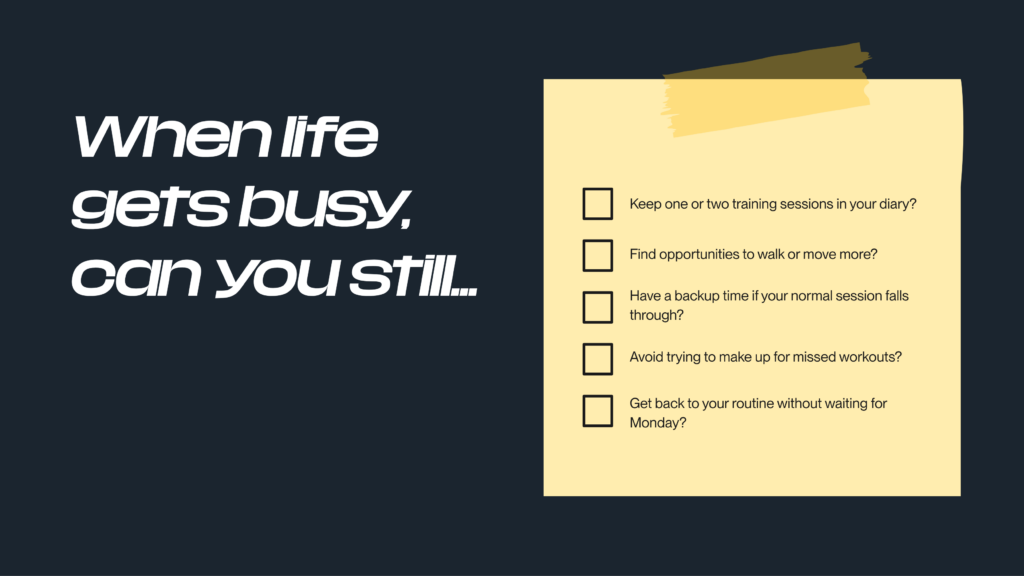
You don’t need to tick every box every week. They’re simply reminders that staying active doesn’t have to be all or nothing.
A routine should work with your life, not against it
There will always be weeks when work is hectic, family commitments take over or things don’t quite go to plan.
And that’s okay.
The key to staying consistent isn’t creating a routine that never changes. It’s finding ways to keep moving, adapting when you need to and making it easier to return when you’ve had some time away.
At The Confidence Coach, we know that our members have busy lives outside the gym. That’s why we focus on Personal Training that’s built around the individual, with expert coaching, a clear plan and sessions throughout the day to help make training a realistic part of their week.
You don’t need a perfect routine. You need one you can keep coming back to.
And over time, those small, consistent efforts are what make the difference.